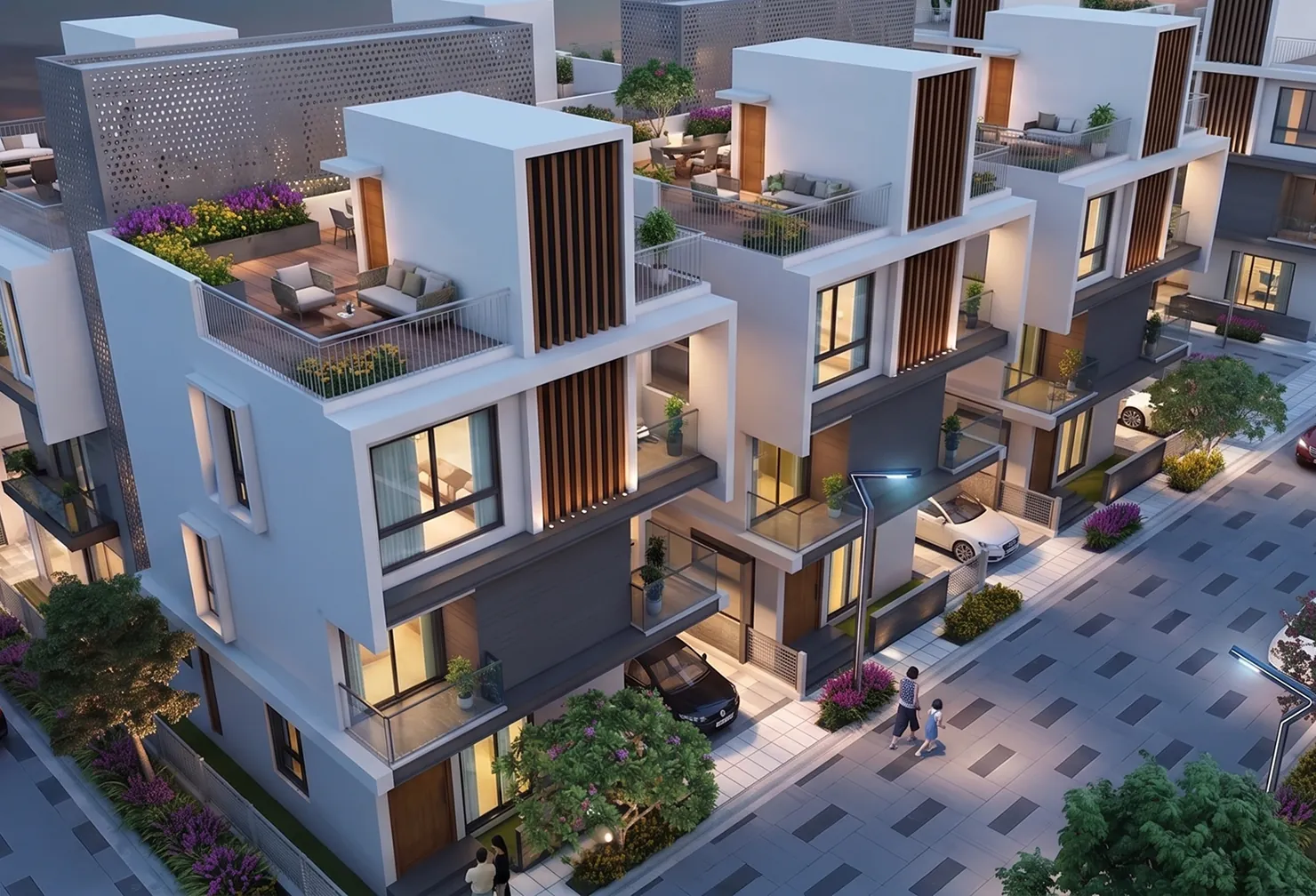
Moving from an apartment to a villa is not simply a shift to a larger home. It changes how space is distributed, maintained and used.
An apartment generally places the entire household on one level. A villa may divide a similar amount of usable space between several floors, staircases, balconies, setbacks and outdoor areas. The villa can offer greater independence and flexibility, but it may also require more planning, furniture and regular maintenance.
Before shortlisting a villa, compare the two formats based on how your family lives—not only on the total square footage advertised.
Compare Usable Space Instead of the Largest Area Number
An apartment and a villa may be marketed using different area calculations. Comparing only the headline figures can create the impression that one home is considerably larger when the difference in usable room area is smaller.
A villa’s stated area may include:
- Multiple floors
- External and internal walls
- Staircases and landings
- Balconies or terraces
- Covered parking
- Utility spaces
- Other constructed areas
Its plot area may also be highlighted, although part of that land may consist of setbacks, parking or narrow spaces around the building.
Ask for the carpet area, built-up area, plot area and floor-wise area breakup. Then compare the dimensions of the rooms your family will use every day.
Buyers exploring villas for sale in Bangalore should compare properties using the same area category rather than placing one project’s plot area against another project’s built-up or carpet area.
Understand How Stairs Change the Feeling of Space
An apartment often feels connected because bedrooms, the kitchen and living spaces are located on the same floor. A villa may contain more total area but feel divided because rooms are distributed vertically.
Consider a family moving from a 2,000 sq. ft. apartment to a 3,000 sq. ft. villa. The villa may provide additional space, but part of it will be allocated to the staircase, landings and circulation between floors. The family may also use only one or two floors regularly.
Walk through the villa while tracing common activities:
- Carrying groceries from parking to the kitchen
- Moving laundry between bedrooms and utility areas
- Supervising children
- Answering the main door from an upper floor
- Reaching a home office
- Carrying luggage to bedrooms
- Cleaning multiple floors
- Serving food on a terrace
Vertical space can create valuable separation, but it also adds movement. Decide whether that movement supports the household or may become tiring.
Check Whether the Villa Provides Meaningful Privacy
Apartments can offer privacy through corridors and bedroom zoning, but household activities still happen on one level. A villa can create stronger separation by placing living areas, bedrooms and workspaces on different floors.
This can benefit families when:
- One person works from home
- Parents or grandparents need a quiet room
- Teenagers require study space
- Guests visit frequently
- Household members have different sleep schedules
- Entertainment areas are used regularly
However, privacy should not become isolation. If bedrooms are several floors away from the living room, family members may spend less informal time together.
Look for a layout that gives people private areas while retaining at least one comfortable shared space where the family can gather naturally.
Decide Whether You Will Use the Private Outdoor Space
A garden, terrace or private courtyard is often one of the strongest reasons to move from an apartment to a villa. It can support gardening, children’s play, pets, outdoor dining or quiet evening use.
However, outdoor space creates value only when it is practical.
Evaluate:
- The shape and dimensions of the garden
- Access from the living or dining area
- Sun exposure during different times
- Privacy from neighbouring villas
- Water and drainage provision
- Safety for children and pets
- Maintenance requirements
- Space for outdoor furniture
- Mosquito and pest management
- Rules affecting permanent outdoor modifications
A narrow setback surrounding the building may add to the plot area without functioning as a usable garden. A smaller, well-connected courtyard may be more valuable.
Ask how often your family currently uses an apartment balcony or common garden. This can provide a realistic indication of whether a private outdoor area will become part of daily life.
Compare Apartment Amenities With Villa-Owned Space
Apartment residents may have access to shared amenities such as a swimming pool, gym, children’s play area, clubhouse, sports facilities and landscaped open spaces.
A villa community may also offer shared amenities, but buyers should not assume they are identical in scale, maintenance or convenience.
Create two lists:
Facilities You Use Regularly
Include amenities used at least once a week, such as a gym, walking path, play area or swimming pool.
Facilities You Rarely Use
Do not give excessive importance to amenities that look attractive during the site visit but are unlikely to influence daily life.
A villa may provide a private garden and additional internal rooms but have fewer shared facilities. Another villa community may combine private space with extensive common amenities.
Compare the lifestyle you actually follow rather than the length of the amenities list.
Prepare for Greater Maintenance Responsibility
In an apartment, the owners’ association or facility-management team usually handles the building exterior, common plumbing, lifts, landscaping and shared infrastructure.
A villa owner may be responsible for more of the individual structure, including:
- Exterior walls
- Roof or private terrace
- Private garden
- Internal plumbing
- Water tanks
- Additional bathrooms
- Balconies
- Gates or compound elements
- Outdoor lighting
- Pest control
- Multiple air-conditioning units
The exact division of responsibilities depends on the community and maintenance agreement. Ask which items are maintained collectively and which belong to the individual owner.
A villa’s additional space can be rewarding, but every extra room and outdoor surface requires cleaning, repair and periodic upkeep.
Estimate the Cost of Furnishing a Larger Home
Furniture from an apartment may not fill a villa in the same way. A second family lounge, larger dining space, terrace or additional bedroom can require new furniture.
Before moving, create a room-by-room furnishing plan:
- Existing furniture that will be reused
- Furniture that will not suit the new layout
- Additional beds and wardrobes
- Curtains and window treatments
- Lighting
- Outdoor furniture
- Storage units
- Work or study furniture
- Appliances for additional floors
- Safety equipment for stairs and balconies
Do not feel pressured to furnish every room immediately. An additional room can remain flexible until the family identifies its most useful purpose.
Buyers comparing 3 BHK villas in Bangalore and 4 BHK villas in Bangalore should consider whether the extra bedroom will be used regularly enough to justify its furnishing and maintenance.
Review Storage More Carefully Than You Would in an Apartment
A villa may have a larger total area but still lack convenient storage. Open plans, staircases and balconies can occupy space without providing places for household items.
Apartment storage is often concentrated in bedrooms, the kitchen and utility area. Villa storage may need to be distributed across floors.
Check for:
- Entry storage for footwear and deliveries
- Pantry space near the kitchen
- Linen storage near bedrooms
- Cleaning cupboards on each floor
- Luggage storage
- Storage below the staircase
- Space for tools and gardening supplies
- Terrace furniture storage
- Parking-level storage
- Utility storage for laundry equipment
Poorly distributed storage can cause family members to carry items repeatedly between floors. Plan storage around where belongings will be used.
Inspect Parking as a Private Functional Area
Apartment parking is generally located in a basement, podium or designated common parking area. A villa may provide parking within or immediately beside the individual plot.
This makes access easier, but the bay must be checked physically.
Confirm:
- Number of vehicles that fit without blocking one another
- Space to open car doors
- Turning and reversing room
- Two-wheeler and bicycle storage
- Weather protection
- Walking access from parking to the entrance
- Electric-vehicle charging provision
- Visitor-parking availability
- Whether parked vehicles reduce garden or entry space
A brochure may show two cars parked comfortably using smaller vehicle illustrations. Measure the bay using the dimensions of the vehicles your household owns.
Understand Sound and Neighbour Relationships
Apartment residents share walls, ceilings or floors with neighbouring homes. A villa can reduce some of this direct sound transfer, but it does not guarantee complete privacy.
Villa residents may still experience noise from:
- Internal community roads
- Neighbouring gardens
- Outdoor gatherings
- Vehicle movement
- Construction in nearby plots
- Pumps or generators
- Clubhouse activity
- Surrounding commercial areas
Within the villa, open staircases and double-height areas can allow sound to travel between floors.
Visit the project at different times if possible. A quiet weekday afternoon may not represent evenings, weekends or school-bus hours.
Examine Security Beyond the Main Gate
Apartment security often includes controlled building entry, lift access, common-area cameras and neighbours living close by.
Villa communities may provide perimeter security and controlled entry, but individual homes have more external access points.
Inspect:
- Main door and secondary entrances
- Garden or utility access
- Ground-floor windows
- Balcony access
- Terrace doors
- Boundary treatment
- Lighting around the plot
- Video-door or intercom provision
- Distance from the security point
- Emergency access
Ask how visitors, delivery workers, domestic staff and service personnel are managed. The community gate is only one layer of security; the individual villa should also be planned carefully.
Compare Utility Arrangements
Moving into a villa can change how household utilities are managed.
Ask about:
- Water source and storage
- Individual or common water tanks
- Sewage connection or treatment system
- Power backup coverage
- Solar-water or solar-power provision
- Waste collection
- Internet-service availability
- Metering of common services
- Rainwater drainage
- Garden water points
Understand which systems are centralised and which require individual maintenance. If power backup covers only common infrastructure, determine which parts of the villa remain supported during an outage.
A larger home may also require stronger Wi-Fi coverage. Check whether wiring or access points are available across floors.
Consider the Relationship With the Community
Apartment living often brings residents into regular contact through lifts, lobbies, corridors and shared amenities. Villa communities may provide greater personal space and fewer unplanned interactions.
Some families value this independence. Others may miss the everyday social contact of an apartment building.
During the project visit, observe:
- Whether common areas encourage interaction
- Walking and play spaces
- Distance between homes
- Community-event areas
- Children’s ability to meet neighbours safely
- Internal-road activity
- Access to the clubhouse
- The general level of privacy
The objective is not to decide which community format is universally better. It is to identify whether the villa environment matches your family’s preferred level of interaction.
Create a “More Space, More Work” Checklist
For every additional space in the villa, write down its intended use and responsibility.
| Additional Villa Space | Intended Benefit | Ongoing Responsibility |
|---|---|---|
| Private garden | Play, pets or outdoor seating | Watering and upkeep |
| Terrace | Gatherings or exercise | Cleaning and waterproofing checks |
| Extra bedroom | Guests, office or parents | Furnishing and cleaning |
| Second lounge | Privacy between activities | Additional furniture |
| Wider parking | Multiple vehicles | Surface and gate upkeep |
| Balcony | Private outdoor access | Cleaning and safety |
| Additional bathroom | Greater convenience | Plumbing and maintenance |
This exercise helps distinguish valuable space from space that may remain underused.
Visit the Villa as an Apartment Resident
During the site visit, pay attention to activities that were previously handled by apartment infrastructure.
Check how you would:
- Receive a delivery when you are upstairs.
- Take rubbish to the collection point.
- Carry groceries from the vehicle.
- Move laundry between rooms and the utility area.
- Clean the terrace and outdoor spaces.
- Supervise children in the garden.
- Manage service staff and maintenance workers.
- Reach shared amenities from the villa.
- Respond to a power or water issue.
- Secure the home before travelling.
These questions reveal whether the lifestyle change feels manageable.
Families considering luxury villas in Whitefield, Bangalore should evaluate both the private home and the community systems supporting it.
What Should Remain on Your Final Comparison Sheet?
Before deciding between your current apartment lifestyle and a shortlisted villa, compare:
- Usable room area
- Number of floors
- Bedroom and bathroom placement
- Private outdoor space
- Shared amenities
- Parking
- Storage
- Security
- Utility management
- Maintenance responsibility
- Furnishing requirement
- Community interaction
- Long-term accessibility
Do not treat the villa as an apartment with extra square footage. Evaluate it as a different way of living.
Conclusion
Moving from an apartment to a villa can provide greater privacy, flexible rooms, private outdoor space and closer parking. It can also introduce stairs, distributed storage, additional furnishing and greater responsibility for maintaining the individual property.
The right villa is not necessarily the largest one. It is the home where the additional space supports activities your family values and where the extra responsibilities remain manageable.
Compare usable space, daily movement, outdoor areas, community facilities and maintenance arrangements before making the transition. This will help ensure the villa improves your everyday life rather than simply increasing the area you own.
Frequently Asked Questions
1. Does a villa always provide more usable space than an apartment?
No. A villa may have a larger stated area, but part of it can be occupied by walls, stairs, balconies and other constructed spaces. Compare carpet area and room dimensions.
2. Is villa maintenance more expensive than apartment maintenance?
It can be because the owner may be responsible for the roof, exterior, garden and additional rooms. The actual responsibility depends on the community’s maintenance agreement.
3. What is the biggest adjustment when moving from an apartment to a villa?
For many families, the biggest adjustment is managing space across multiple floors while taking greater responsibility for the individual building and outdoor areas.
4. Should apartment furniture be replaced when moving to a villa?
Not necessarily. Reuse suitable furniture first and live in the villa before furnishing every additional room. This helps prevent unnecessary purchases.
5. Do villa communities provide the same amenities as apartments?
Some do, but the type, scale and accessibility of amenities vary. Compare the facilities your family will use regularly rather than relying on the total amenities list.