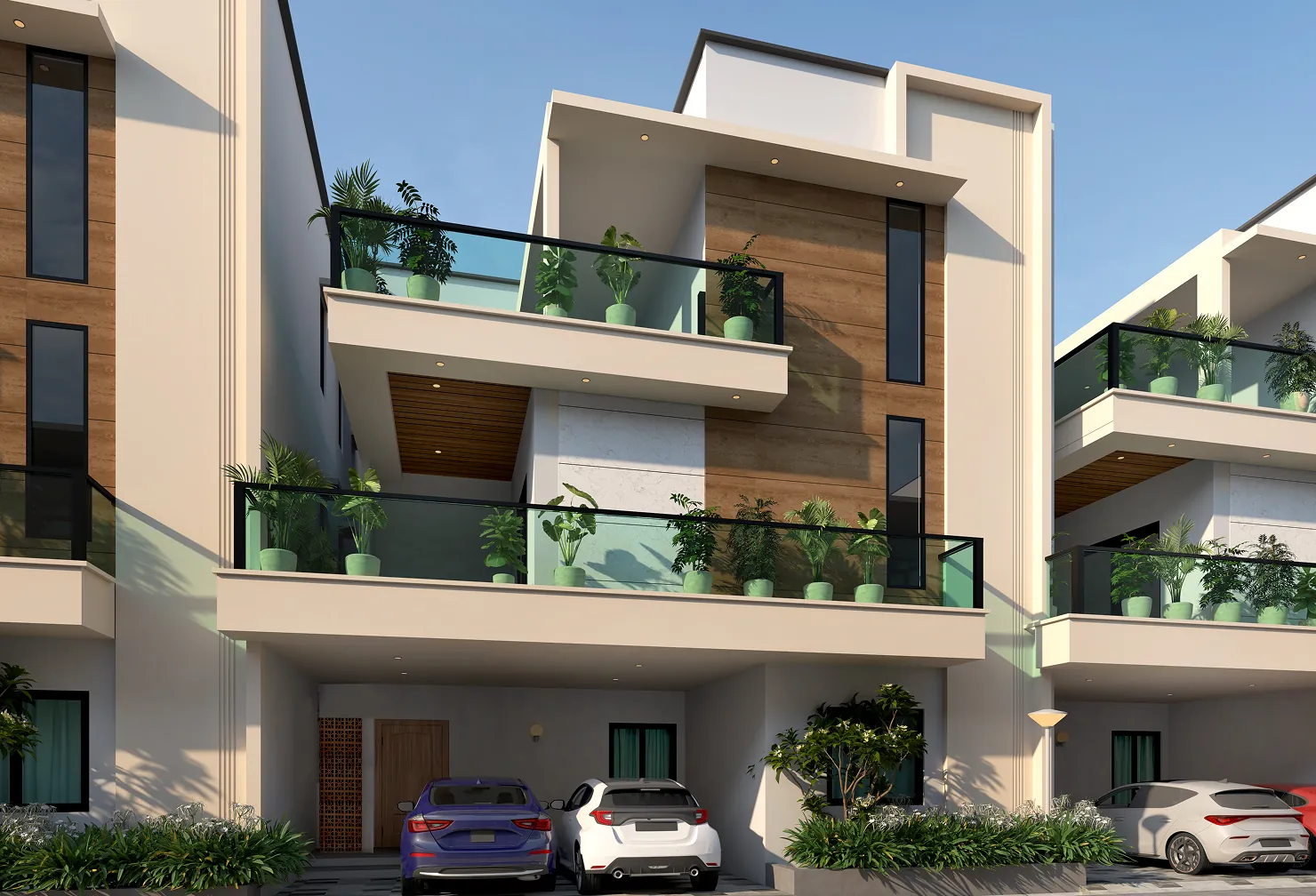
Wide internal roads and convenient visitor parking can significantly affect life inside a villa community. These features influence everyday driving, pedestrian safety, emergency access, school-bus movement and the privacy of individual homes.
A master plan may show broad roads and neatly arranged parking spaces. The completed experience can be different when residents park additional vehicles on the street, visitors stop near villas and service vehicles use the same routes.
Buyers should examine how the entire circulation system is expected to work, not only the parking space provided within an individual villa.
Distinguish Internal Roads From the Approach Road
The approach road connects the project to the surrounding neighbourhood or main road. Internal roads begin at the community gate and carry residents and visitors to individual villas and amenities.
Both need to work, but they should be evaluated separately.
For the internal network, identify:
- Main entrance road
- Secondary residential streets
- Roads leading to the clubhouse
- School-bus route
- Service-vehicle route
- Emergency access
- Visitor-parking areas
- Turning spaces
- Pedestrian paths
- Exit gate, where provided
Families comparing villas in Whitefield, Bangalore should trace the complete route from the security gate to the shortlisted villa. The road beside the model home may not represent the street serving the selected unit.
Confirm the Usable Road Width
A road’s stated width may include drains, landscaped edges, walkways or other elements that vehicles cannot use.
Ask whether the quoted measurement refers to:
- Total right of way
- Carriageway available to vehicles
- Footpath and landscape areas
- Drainage infrastructure
- Parking bays
- Building setbacks
Then inspect the clear width available for movement.
A road may appear spacious when no vehicles are parked. Its performance can change when cars stand along one side, a delivery vehicle stops near a gate or two larger vehicles meet.
Check whether two cars can pass without one reversing. Also consider school buses, ambulances, fire vehicles, moving trucks and waste-collection vehicles.
The narrowest bend or junction may determine how the entire road functions.
Review the Road Hierarchy
A well-planned villa community usually has different roads for different levels of movement. The main road may carry visitors and service vehicles, while smaller streets serve quieter residential clusters.
Study whether the layout distinguishes between:
- Main community circulation
- Residential lanes
- Clubhouse access
- Service access
- Pedestrian paths
- Emergency routes
A villa on the main spine road may offer convenient access but receive more passing traffic. A home within an internal lane may feel quieter but require travelling through several turns to reach the gate.
Neither position is automatically better. Buyers should match it to their preferences regarding privacy, children’s outdoor movement, driving convenience and proximity to amenities.
Test the Route to the Selected Villa
Drive from the entrance to the villa instead of reviewing the route only on the site plan.
Observe:
- Number of turns
- Sharp bends
- Road gradients
- Speed breakers
- Visibility at junctions
- Space around landscaped islands
- Vehicles parked near corners
- Pedestrian movement
- Distance from the gate
- Ease of finding the unit
Repeat the route in the opposite direction. Entry into the villa’s parking area may be simple, while reversing out during busy periods may be more difficult.
If the development is under construction, ask how the route will change when all landscaping, parking bays, signage and street furniture are installed.
Check the Villa’s Parking Space With Your Own Vehicle
The number of parking spaces shown in a plan does not establish whether those spaces are comfortable to use.
Where possible, test the parking bay with the type of vehicle your family owns.
Check:
- Clear length and width
- Space to open all doors
- Turning movement from the road
- Access when a vehicle is parked opposite
- Room for two-wheelers
- Position of pillars and walls
- Slope between the road and parking area
- Gate-opening movement
- Access to the main entrance
- Space for a second car, where required
A bay may technically fit two cars but require one vehicle to be moved before the other can leave. Decide whether that arrangement is practical for the household’s daily schedules.
Buyers considering premium 4 BHK villas in Whitefield may have multigenerational households with more than one vehicle. Parking capacity should be assessed against actual family use.
Understand the Visitor-Parking Plan
Visitors should not have to block residential roads or individual villa entrances.
Ask the project team:
- How many visitor spaces are planned?
- Where are they located?
- Are they distributed across the project?
- Are spaces marked and managed?
- Can visitors park overnight?
- Is additional parking available during events?
- How will unauthorised parking be handled?
- Are accessible parking spaces provided near amenities?
- Can cabs and drivers wait without blocking traffic?
A single visitor-parking area near the entrance may reduce traffic inside the community but create a long walk to distant villas. Distributed parking may be more convenient but bring additional vehicle movement into residential streets.
The more suitable arrangement depends on the project’s size and internal layout.
Estimate Demand During Busy Periods
Visitor parking should be evaluated when demand is high, not only during an ordinary weekday afternoon.
Consider:
- Weekends
- Festivals
- Family gatherings
- Clubhouse events
- Community celebrations
- School-bus periods
- Deliveries during evenings
- Move-in and move-out activity
- Maintenance work
When visitor spaces fill up, drivers may park along internal roads, near junctions or in front of other villas. This can reduce visibility and obstruct larger vehicles.
If the project is occupied, visit during an evening or weekend. Observe how the community manages actual demand rather than depending only on the approved parking arrangement.
Evaluate School-Bus Movement
School buses can create concentrated activity in the morning and afternoon.
Confirm whether buses:
- Enter the community
- Stop at individual clusters
- Use a central pickup point
- Turn without reversing
- Wait on the main internal road
- Block resident vehicles
- Have a safe boarding area
- Share the space with visitor parking
A central pickup point can reduce large-vehicle movement near villas, but children may need to walk farther. Multiple pickup points may be more convenient while increasing internal traffic.
Inspect pedestrian paths between the villas and the bus stop. Children should not need to cross active parking or turning areas without clear visibility.
Check Pedestrian Safety
Internal roads are shared by drivers, children, elderly residents, domestic staff, delivery workers and people walking pets. Road width alone does not guarantee safety.
Look for:
- Continuous footpaths
- Safe crossings
- Street lighting
- Speed-control measures
- Visibility at bends
- Separation from parked vehicles
- Accessible walking surfaces
- Safe routes to amenities
- Protection around play areas
- Clear pedestrian space near gates
Poorly positioned parking can hide children and pedestrians from approaching drivers. Large landscaping elements near corners may also reduce visibility.
Speed breakers should slow vehicles without making ambulance or elderly access unnecessarily difficult. Ask how the community plans to enforce speed limits after occupation.
Verify Emergency-Vehicle Access
Emergency access should remain clear even when visitor parking is heavily used.
Walk or drive the likely emergency route and identify:
- Narrow bends
- Low branches or structures
- Parked vehicles
- Tight turning areas
- Gate restrictions
- Speed barriers
- Dead-end roads
- Villa-number visibility
- Alternative routes
- Access to common facilities
Emergency vehicles should be able to reach every residential cluster without depending on several parked cars being moved.
Ask whether the community has designated no-parking zones and how security personnel keep them clear. Painted markings alone may not be effective without consistent management.
Consider Deliveries and Service Vehicles
Villa communities receive regular movement from couriers, food delivery workers, taxis, domestic-service providers, maintenance teams and waste-collection vehicles.
Find out whether:
- Deliveries are allowed to reach individual villas
- Drivers must wait at the entrance
- Cabs can enter the community
- Service vehicles have assigned routes
- Loading and unloading areas are available
- Moving trucks require advance permission
- Waste vehicles stop on residential roads
Restricting all delivery vehicles at the gate may reduce internal traffic but create inconvenience for elderly residents or heavy deliveries. Allowing unrestricted access may increase movement near homes.
The community needs a workable system that balances convenience, security and road capacity.
Examine Drainage Along Internal Roads
Road design must also manage rainwater without creating hazards for vehicles and pedestrians.
Inspect:
- Road slopes
- Drainage openings
- Low points
- Water flow near parking bays
- Covered or open drains
- Levels around villa entrances
- Footpath drainage
- Signs of standing water
- Maintenance access
Water collecting near a parking bay can make entry difficult and damage road edges. Poor drainage may also push water towards individual plots or pedestrian routes.
If possible, visit after rainfall or ask existing residents how quickly internal roads clear.
Review Parking Rules and Long-Term Management
Physical design is only one part of the issue. Community rules determine how roads and parking perform after occupation.
Ask for clarity on:
- Resident street parking
- Second and third vehicles
- Visitor permits
- Overnight visitor parking
- Commercial vehicles
- Abandoned vehicles
- Parking near corners
- Charging points for electric vehicles
- Penalties for obstruction
- Responsibility for enforcement
A community may begin with limited parking pressure and experience greater demand as households acquire additional vehicles.
Rules should anticipate long-term use instead of assuming every family will remain within its original parking allocation.
Use an Internal-Road and Parking Scorecard
| Factor | What to Evaluate |
|---|---|
| Usable road width | Clear carriageway after vehicles are parked |
| Road hierarchy | Separation of main, residential and service movement |
| Villa parking | Size, turning space and everyday usability |
| Visitor parking | Number, distribution and event-day capacity |
| Pedestrian safety | Footpaths, crossings, lighting and visibility |
| Large vehicles | School buses, ambulances and moving trucks |
| Drainage | Water flow around roads and parking areas |
| Management | Parking rules, enforcement and future demand |
Apply the same checks to each shortlisted project. A wide-road claim should not receive a high score unless the complete network remains usable during realistic conditions.
Conclusion
Internal roads and visitor parking influence much more than the appearance of a villa community. They affect driving convenience, pedestrian safety, emergency response, deliveries and privacy around individual homes.
Confirm the usable road width, drive the route to the selected villa and test the private parking bay with a suitable vehicle. Review visitor demand during weekends and events, then check how school buses and emergency vehicles move through the development.
Once the circulation system qualifies, buyers can compare luxury villas in Whitefield, Bangalore and the broader range of villas for sale in Bangalore with a clearer understanding of how the community will function after occupation.
Frequently Asked Questions
1. Is the advertised internal-road width always the usable width?
No. The quoted width may include footpaths, drains or landscaped areas. Buyers should confirm the clear carriageway available to vehicles.
2. How much visitor parking should a villa project provide?
There is no single number suitable for every project. Capacity should reflect the number of villas, community layout, visitor patterns and clubhouse use.
3. Why should buyers inspect parking on a weekend?
Weekends can reveal visitor demand, roadside parking and traffic conditions that may not appear during a weekday property visit.
4. Should school buses enter a villa community?
Either arrangement can work. Buyers should compare internal traffic with the safety and walking distance of a central pickup point.
5. What should buyers check about emergency access?
Confirm gate procedures, road width, turning space, no-parking zones and whether emergency vehicles can reach every villa without avoidable obstruction.